

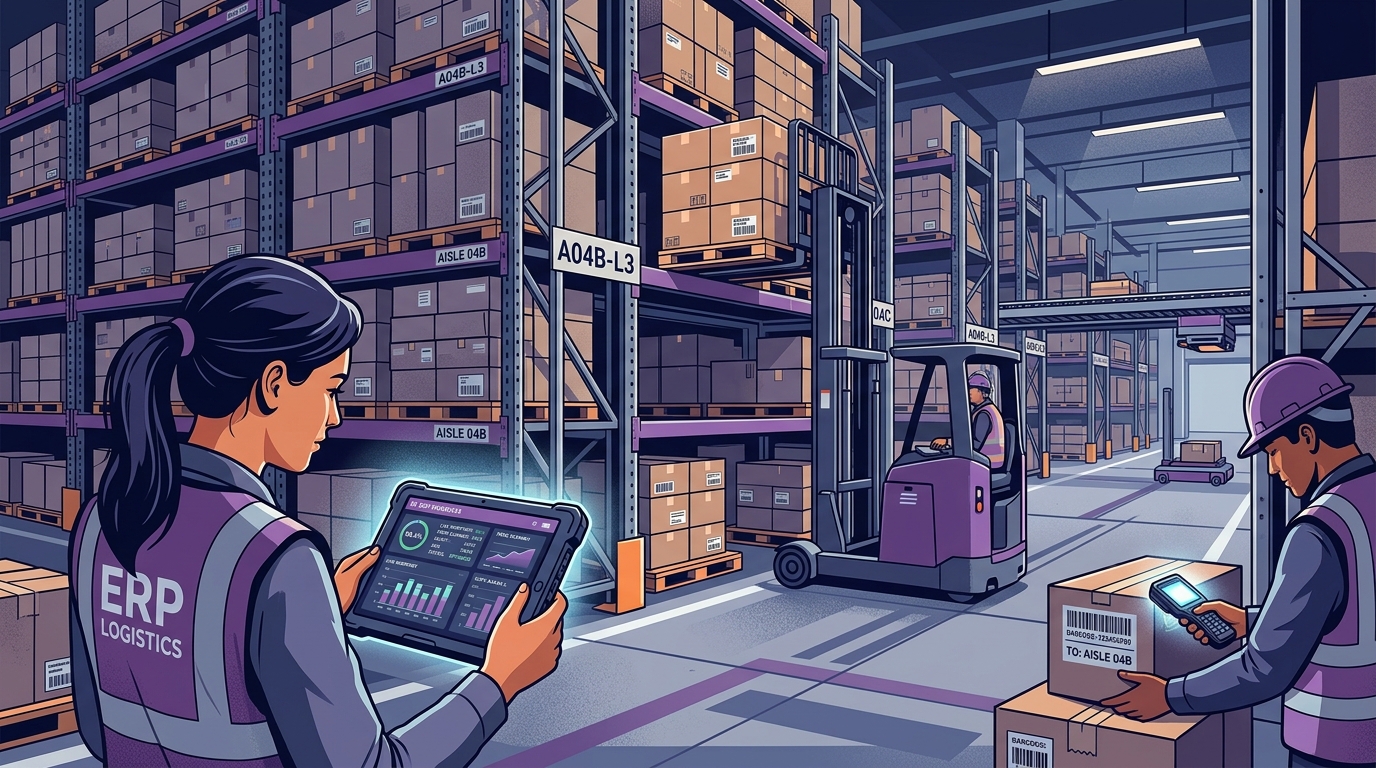
Inventory is one of the largest financial assets on any balance sheet. For manufacturers, distributors, wholesalers, and retail enterprises, effective inventory management directly determines cash flow, on-time customer delivery, production continuity, storage overhead, and overall profitability.
Carrying too much inventory ties up vital working capital, inflates holding costs, and increases the risk of obsolescence or damage. Conversely, carrying too little inventory triggers expensive emergency purchases, machine downtime, missed shipping deadlines, and frustrated customers.
When a business handles thousands of SKUs across multiple warehouses, managing stock through disconnected spreadsheets becomes impossible. Enterprise Resource Planning (ERP) software transforms inventory management by uniting stock movements with sales demand, procurement, production planning, quality control, and financial accounting.
Quick Answer: How Does ERP Improve Inventory Management?
ERP software improves inventory management by establishing a real-time, centralized single source of truth across all items, warehouses, and transactions. Every physical movement—such as vendor goods receipts, sales dispatches, shop-floor material issues, production completions, and branch transfers—automatically updates stock balances, triggers safety reorders, prevents double-selling, and recalculates accurate financial valuations.
The 6 Core Categories of Enterprise Inventory
Modern ERP systems classify and track stock across distinct operational stages:
1. Raw Materials
Primary commodities, metals, chemicals, and polymers used directly in manufacturing.
2. Work-in-Progress (WIP)
Semi-finished goods currently undergoing cutting, machining, assembly, or curing.
3. Finished Goods
Completed, QC-inspected items packed and available in warehouse bays for dispatch.
4. Sub-Assemblies & Parts
Modular sub-units, motors, fasteners, and bought-out components required in BOMs.
5. Consumables & MRO
Cutting oils, lubricants, grinding wheels, tools, and spare parts for machinery maintenance.
6. Packaging Materials
Corrugated boxes, protective wrap, strapping, custom cartons, and shipping labels.
Why Spreadsheet Inventory Breaks Down as You Grow
For a startup tracking 20 products in one room, a single spreadsheet with
Opening + Purchases - Sales = Closing is manageable. But as operational
complexity compounds, manual spreadsheets create critical vulnerabilities:
10+ regional warehouses & distribution hubs
Hundreds of daily inward receipts and dispatches
Multi-level BOM material explosions & scrap allowances
Inter-warehouse stock transfers & in-transit delays
Strict batch expiry dates & serial number warranty tracking
When different departments maintain independent spreadsheets, stock figures diverge. Purchasing orders duplicate items, sales promises unavailable stock, and shop-floor machinery sits idle waiting for missing fasteners.
17 Core Ways ERP Software Transforms Inventory Management
1. Centralized Master Data & Multi-Warehouse Tracking
ERP maintains a unified item master across all physical locations. Management views granular stock balances by warehouse, aisle, rack, and bin, while simultaneously seeing consolidated enterprise-wide totals.
2. Real-Time Transaction Movements
Instead of periodic manual updates, inventory balances update live with every operational transaction: vendor GRN inwarding, sales dispatches, shop-floor material issues, and quality returns.
3. Sales Order Demand & Automated Stock Reservations
When a sales order is booked, ERP immediately distinguishes between Physical Stock, Reserved Stock (allocated to confirmed orders), and Available-to-Promise (ATP) Stock. This eliminates double-commitments and prevents fulfillment delays.
4. Stockout Prevention & Dynamic Reorder Levels
ERP calculates minimum safety stock thresholds and automated reorder points based on average consumption rates and supplier lead times, ensuring purchase requisitions trigger before raw materials run dry.
5. Controlling Excess, Aging & Slow-Moving Stock
Capital tied up in stagnant inventory reduces liquidity. ERP automated ABC Analysis and aging reports classify stock into fast-moving, slow-moving, and non-moving categories, enabling proactive discounting or stock redeployment.
6. Inter-Warehouse Transfers & In-Transit Tracking
Moving inventory between regional hubs requires structured transfer orders. ERP tracks stock as "In-Transit" from dispatch until physical receipt confirmation at the destination warehouse, preventing unaccounted stock loss.
7. Raw Material BOM Explosion & Shortage Analysis
For manufacturers, ERP explodes multi-level Bills of Materials (BOMs) against production plans. The Material Requirements Planning (MRP) engine cross-checks required components against free warehouse stock and generates instant shortage purchase requests.
For a comprehensive guide on production routing, read our post on streamlining production planning and scheduling with ERP.
8. Work-in-Progress (WIP) Shop Floor Tracking
Materials issued to production do not disappear into a black box. ERP tracks semi-finished inventory across stages (cutting → machining → assembly → testing), maintaining precise valuation and location visibility.
9. Finished Goods Inwarding & Production Reconciliations
When shop-floor production finishes, completed items undergo Quality Control (QC) inspection. Passed quantities are instantly transferred into finished goods inventory, updating sales dispatch availability in real time.
10. Material Consumption & Scrap Variance Analysis
ERP compares standard BOM material allowances against actual shop-floor consumption. Any excess consumption or rework scrap is logged with variance reasons for engineering review.
11. Batch / Lot Tracking & Expiry Date Management
For pharmaceuticals, food processing, chemicals, and plastics, ERP assigns unique batch numbers at goods receipt. The system enforces FEFO (First-Expired, First-Out) dispatch rules and enables one-click traceability during product recalls.
12. Individual Serial Number Traceability
High-value machinery, electronics, and automotive equipment are tracked by individual serial numbers throughout their lifecycle, linking specific components to customer delivery dates and warranty contracts.
13. Procurement Synchronization & 3-Way Match
Inventory coordinates directly with purchasing. When raw materials arrive, ERP performs an automated 3-Way Match between the Purchase Order, Goods Receipt Note (GRN), and Vendor Tax Invoice before approving payments.
14. Real-Time Financial Inventory Valuation
Stock is not just a unit count—it represents balance sheet capital. ERP maintains real-time valuation using FIFO (First-In, First-Out), Weighted Average Costing, or Standard Costing, instantly syncing with general ledger accounts.
15. Controlled Stock Audits & Discrepancy Adjustments
Discrepancies caused by handling loss, transit damage, or counting errors are managed through formal stock adjustment vouchers with mandatory approval permissions and audit trails.
16. Barcode, QR Code & Handheld Mobile Scanning
Warehouse staff scan barcode and 2D QR labels using mobile handheld devices or rugged scanners during put-away, bin picking, packing, and dispatch, eliminating manual keyboard errors.
17. Executive Inventory Dashboards & 10 Critical Reports
Leadership monitors real-time inventory health through visual dashboards displaying total stock valuation, low-stock alerts, out-of-stock SKUs, pending receipts, and turnover ratios.
Inventory Management: Excel vs. Integrated ERP
| Feature / Area | Spreadsheets (Excel) | Integrated Uttercode ERP |
|---|---|---|
| Stock Updates | Manual data entry after hours | Live transaction-based updating |
| Multi-Warehouse Tracking | Scattered, disconnected files | Centralized multi-location control |
| Sales Allocation | Blind promises & accidental double-selling | Automated Available-to-Promise (ATP) |
| Manufacturing BOMs | Fragile formulas prone to corrupt cells | Multi-level automated MRP explosions |
| Batch & Serial Traceability | Extremely complex & error-prone | Native batch, lot, and serial tracking |
| Reorder Triggers | Manual checks & guesswork | Automated min/max safety stock alerts |
| Valuation & General Ledger | Manual monthly calculations | Real-time FIFO & Weighted Average sync |
| Barcode Integration | Not supported natively | Handheld mobile barcode & QR scanning |
| Audit Trail | No log of deleted or changed cells | Complete timestamped user audit log |
10 Warning Signs Your Business Has Outgrown Spreadsheet Inventory
9 Vital Inventory KPIs Every Operations Leader Must Monitor
ERP analytics provide clear, continuous visibility into core operational metrics:
1. Inventory Accuracy Rate
Percentage of physical stock counts matching ERP records. Target: 98–99.5%.
2. Inventory Turnover Ratio
How frequently inventory is sold or consumed per year. Higher ratios indicate efficient capital use.
3. Days of Inventory on Hand (DSI)
Average days required to turn current stock into sales or finished products.
4. Stockout Frequency Rate
Percentage of orders delayed due to raw material or finished product shortages.
5. Inventory Carrying Cost
Total cost of holding stock (storage, insurance, obsolescence, interest). Typically 20–30% of stock value.
6. Material Consumption Variance
Difference between standard BOM requirements and actual physical consumption on the floor.
The Connected Uttercode ERP Inventory Pipeline
Inventory reaches maximum value when integrated into the end-to-end business operating cycle:
26-Point ERP Inventory Evaluation Checklist
Ensure your ERP software includes the essential tools required for total inventory control:
- Centralized multi-warehouse master
- In-transit stock transfer tracking
- Automated Available-to-Promise (ATP)
- Multi-level BOM material explosions
- Automated MRP shortage calculations
- Dynamic safety stock & reorder levels
- Batch & Lot tracking with expiry (FEFO)
- Serial number tracking & warranty logs
- Handheld mobile barcode / QR scanning
- Real-time FIFO & weighted average valuation
- Work-in-Progress (WIP) routing control
- Material consumption & scrap logging
- Quality Control (QC) gate approvals
- 3-Way matching (PO vs. GRN vs. Invoice)
- Physical stock audit reconciliation tools
- Controlled stock adjustment vouchers
- ABC classification & inventory turnover
- Slow-moving & aging inventory reports
- Role-based permissions by warehouse
- Full timestamped transaction audit trail
- Negative stock prevention rules
- Digital weighbridge hardware API support
- One-click GST e-Way bill integration
- Mobile smartphone warehouse app
- Executive inventory valuation dashboards
- Automated low-stock email & WhatsApp alerts
Ready to Eliminate Stockouts and Optimize Working Capital?
Discover how Uttercode ERP connects multi-warehouse inventory, automated MRP calculations, and shop-floor tracking in one integrated platform.
Frequently Asked Questions
What is inventory management in ERP?
Inventory management in ERP is the process of tracking, controlling, and optimizing materials and products across purchasing, goods receipt, multi-warehouse storage, BOM consumption, work-in-progress (WIP), finished goods, batch/serial tracking, dispatch, and financial valuation in one unified system.
How does ERP improve inventory accuracy?
ERP software improves inventory accuracy to 99%+ by replacing manual spreadsheet data entry with real-time transaction recording, barcode/QR scanning, role-based access control, automatic stock reservations, and structured physical audit reconciliation.
Can ERP manage multiple warehouses and branches?
Yes. ERP provides multi-warehouse stock visibility, location-to-location transfer orders with in-transit tracking, branch-level stock allocation, and consolidated enterprise stock valuation.
How does manufacturing ERP connect inventory with production?
Manufacturing ERP links multi-level Bills of Materials (BOM) to live inventory, calculating raw material shortages, reserving available stock, issuing materials against job cards, tracking work-in-progress (WIP), and automatically adding finished goods to warehouse stock upon QC approval.
Can ERP prevent stockouts and excess inventory?
Yes. ERP monitors minimum safety stock thresholds, calculates dynamic reorder levels based on supplier lead times, and flags aging/slow-moving inventory through ABC classification reports to protect cash flow.
How does batch and serial number tracking work in ERP?
ERP assigns unique batch/lot numbers (with manufacturing and expiry dates) or individual serial numbers to items during goods receipt, maintaining complete end-to-end traceability across storage, production consumption, and customer sales dispatch.
What are the common inventory valuation methods supported by ERP?
ERP systems automatically calculate real-time inventory valuation using FIFO (First-In, First-Out), Weighted Average Costing, or Standard Costing, instantly synchronizing operational stock balances with general ledger accounts.
Why is Excel not enough for growing inventory operations?
Excel relies on static formulas that do not update in real time, cannot enforce role-based access control, lacks barcode scanner integration, cannot automate multi-level BOM explosions, and creates conflicting spreadsheet versions across departments.
What key inventory KPIs should businesses track in ERP?
Key KPIs include Inventory Accuracy Rate, Inventory Turnover Ratio, Stockout Frequency, Days of Inventory on Hand (DSI), Inventory Carrying Cost, Material Consumption Variance, and Dead Stock Percentage.
Conclusion
Effective inventory management is far more than knowing what sits on warehouse shelves. It is about answering critical business questions in real time: What do we have? Where is it? How much is committed to sales orders? What raw materials are needed for next week's production? What is moving slowly? And how much working capital is tied up in stock?
By uniting inventory with sales, procurement, manufacturing, and financial accounting, an integrated ERP eliminates stockouts, lowers carrying overhead, streamlines warehouse logistics, and provides executive leadership with accurate, actionable visibility.
"Better inventory control begins with connected visibility. An integrated ERP gives your business the structure and real-time intelligence needed to scale profitably."