

Chhatrapati Shahu Maharaj Hospital
Jalgaon, Maharashtra • Hospital Operations DigitalizationDigitizing Hospital Operations with Uttercode Hospital Management – Healthcare
Discover how Chhatrapati Shahu Maharaj Hospital, Jalgaon transformed daily hospital care by transitioning from disjointed departmental files to a unified digital platform connecting patient registration, OPD, EMR, investigations, pharmacy, IPD bed management, billing, and accounts under one integrated architecture.
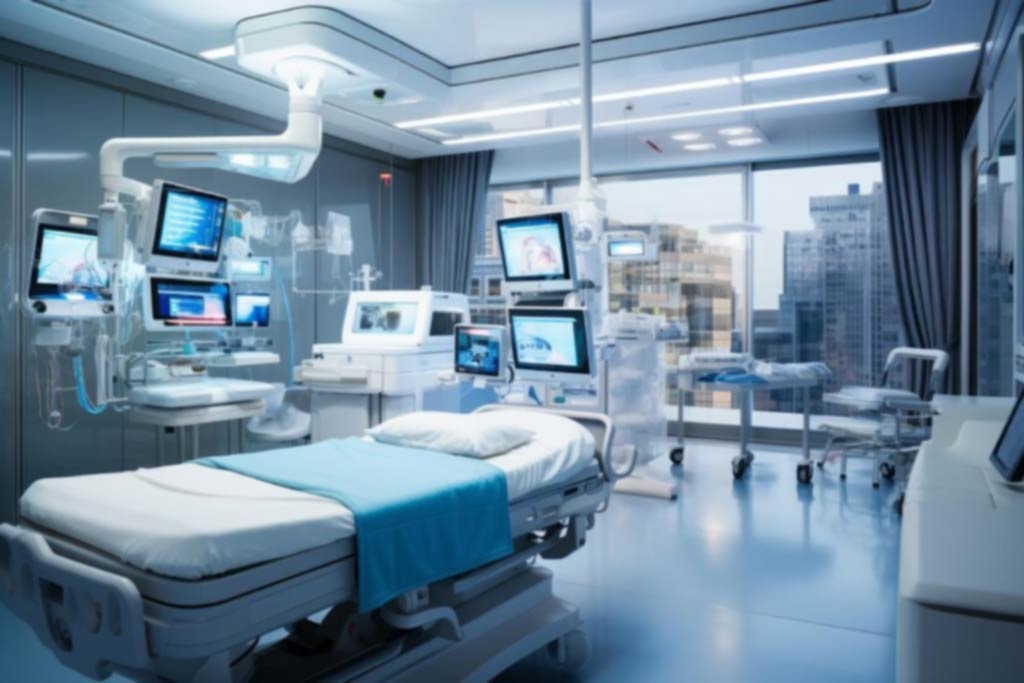
One Connected Hospital
Unifying Clinical & Administrative Operations1. Client Overview
Institution ProfileChhatrapati Shahu Maharaj Hospital, Jalgaon is a comprehensive healthcare organization dedicated to providing essential clinical and inpatient services to the region.
The Multi-Departmental Nature of Modern Hospital Care
Managing a hospital involves significantly more than simply maintaining static patient records. Every single day, multiple interconnected departments work simultaneously to deliver continuous patient care:
When these departments operate independently, hospital staff are forced to maintain multiple paper registers, physical case sheets, standalone billing tools, and manual stock ledgers. A patient visiting for an OPD consultation generates demographic data at reception, clinical notes with the doctor, test requisitions in the lab, medicine dispenses at the pharmacy, and payment entries at the cash counter.
The objective of this digital transformation was to create a centralized hospital management platform that seamlessly connects patient information, clinical decisions, administrative workflows, and financial transactions. This requirement was comprehensively addressed through Uttercode Hospital Management – Healthcare.
2. The Business Challenge
Hospitals generate a massive volume of synchronized operational data every day. When departments lack real-time digital integration, severe operational bottlenecks emerge.
Duplicate Registrations
Patients returning for repeat visits were frequently registered with new serial numbers, creating fractured medical records and lost history.
Paper Clinical Records
Doctors lacked immediate access to past diagnoses, vitals progression, previous prescriptions, and lab test results during active consultations.
Manual Queue & Appointments
Chaotic waiting areas, long patient wait times, and overlapping doctor schedules due to manual token and appointment registers.
Disconnected Lab Tracking
Diagnostic test requisitions and reports had to be hand-carried across wards, causing diagnostic delays and lost paper test sheets.
Pharmacy Inventory Losses
Lack of batch-level expiry tracking and inventory reconciliation caused stockouts of vital emergency medicines and financial expiry write-offs.
Billing & Reconciliation Gaps
Unbilled nursing procedures, missed diagnostic test charges, delayed discharge summaries, and time-consuming end-of-day revenue audits.
3. The Digital Transformation Objective
One Patient. One Record. One Connected Hospital.
The primary goal was to create a centralized digital platform where authorized doctors, nurses, pharmacists, lab technicians, and accountants access exactly what they need in real time.
Registration
Unique UHIDAppointment
Doctor QueuesOPD Clinic
Vitals & TokensConsultation
Digital NotesInvestigations
Lab & RadiologyPrescription
Digital RxPharmacy
Batch DispenseIPD Admission
Bed & Ward CareDischarge
Summary & BillsFollow-Up
Continuous CarePATIENT → REGISTRATION (UHID) → APPOINTMENT → OPD → DOCTOR CONSULTATION ↓ INVESTIGATIONS (LAB / RADIOLOGY) + DIGITAL PRESCRIPTION ↓ PHARMACY DISPENSING → BILLING → IPD / WARD ADMISSION → NURSING CARE ↓ DISCHARGE SUMMARY → FINAL BILLING & SETTLEMENT → ACCOUNTS & FOLLOW-UP
4. The Uttercode Solution
Uttercode Hospital Management – Healthcare
Uttercode provides an integrated healthcare enterprise suite engineered to eliminate departmental silos and bring clinical excellence, operational transparency, and financial integrity onto one common platform.
5. Patient Registration & UHID
The patient journey begins with a centralized digital identity. Uttercode maintains a single Master Patient Index assigning a lifelong Unique Health Identification (UHID).
Once registered, any subsequent visit across OPD, IPD, Emergency, or Diagnostic labs instantly links to this central UHID, eliminating duplicate chart creation.
6. Centralized Patient History
Instead of searching through physical archives or missing paper folders, authorized clinical staff view a consolidated chronological timeline:
Patient Profile (UHID)
      ↓
Previous Visits & Consultations → Clinical Diagnoses
      ↓
Prescriptions Dispensed → Laboratory & Radiology Reports
      ↓
Inpatient Admissions → Nursing Charts → Discharge Summaries
      ↓
Consolidated Billing & Follow-Up Care
Complete clinical continuity ensures doctors make informed diagnostic decisions based on verified longitudinal health records.
Outpatient Operations — Steps 7 to 10
Streamlining appointments, live patient queues, clinical documentation, and longitudinal electronic medical records.
Appointment System
Structured scheduling for new and follow-up visits, doctor session schedules, walk-in tokens, automated SMS reminders, and real-time waiting list tracking.
OPD Management
Token generation, initial nurse triage vitals recording (BP, Pulse, SpO2, Temperature, Weight), and dynamic queue screens directing patients to consultation rooms.
Doctor Consultation
Specialist clinical interface for capturing chief complaints, physical findings, ICD diagnoses, digital Rx, diagnostic investigation orders, and follow-up dates.
Electronic Medical Records
Structured visit-by-visit record: Visit 001 (Consultation & Diagnosis), Visit 002 (Lab Reports & Prescription Adjustments), Visit 003 (Procedure & Recovery).
11 & 12. Laboratory & Radiology Diagnostic Services
Eliminating handwritten lab requisitions and physical report delivery through closed-loop digital diagnostic workflows.
11. Laboratory Management (LIS)
Diagnostic test requests ordered by doctors automatically appear on the lab technician's dashboard. The LIS handles the full testing lifecycle:
Doctor Investigation Order
            ↓
Sample Collection & Barcode Phlebotomy
            ↓
Analyzer Processing & Result Entry
            ↓
Pathologist Verification & Digital Signature
            ↓
Auto-Published to Patient EMR & SMS Alert
12. Radiology & Diagnostic Services
Coordinates specialized medical imaging and non-invasive cardiac diagnostics across hospital departments:
13 & 14. Pharmacy & Hospital Inventory Management
Real-time medicine dispensing, batch-expiry auditing, and closed-loop hospital consumable distribution.
13. Pharmacy Management
When a doctor prescribes medications digitally, the prescription flows instantly to the hospital pharmacy counter, enabling rapid, error-free dispensing:
14. Inventory & Hospital Stores
Hospitals consume hundreds of medical supplies beyond oral medications. Uttercode tracks all department requisitions and store receipts:
IPD Operations — Steps 15 to 18
Complete inpatient lifecycle management from admission bed allocation to continuous nursing notes and formal discharge summaries.
15. Inpatient Department (IPD) Management
When a doctor recommends admission, the patient transitions into the IPD module. The system manages admitting diagnoses, attending consultants, daily doctor rounds, clinical orders, OT schedules, and procedure charges:
Admission Request → Bed Allocation → Daily Rounds → Nursing Care
                 ↓
Continuous Medication & Procedures & Daily Automated Room Charges
                 ↓
Clinical Stabilization & Discharge Order
16. Bed & Ward Management Matrix
Admissions staff view a real-time, interactive color-coded floor grid of all hospital beds across General Wards, Semi-Private, Deluxe Rooms, and ICUs:
17. Nursing Management & MAR
Ward nurses access a dedicated clinical station to carry out doctor treatment plans without physical paper chart errors:
- Periodic vital signs charting (BP, Pulse, RR, Pain score).
- Medication Administration Record (MAR) with scheduled dosage checklists.
- Shift handover notes and critical clinical incident logging.
- Direct pharmacy indenting for IV fluids, injectables, and dressings.
18. Structured Discharge Management
The discharge process consolidates clinical documentation and financial clearance seamlessly:
19. Integrated Billing Management
Hospital services link directly to financial billing without manual reconciliations. As services are provided across wards, labs, and OT, bill items populate automatically:
Handles advance deposits, concession approvals, multi-mode payments (Cash, UPI, Card, NEFT), refunds, and transparent itemized receipts.
20. Insurance & TPA Claim Workflow
Provides dedicated workflows for private health insurers, Third-Party Administrators (TPAs), and government healthcare schemes:
Patient Registration & TPA Card Verification
                 ↓
Initial Pre-Authorization Request & Approval Limit
                 ↓
Inpatient Treatment & Diagnostic Billing Records
                 ↓
Final Claim Dossier Preparation (Bills + EMR + Reports)
                 ↓
Claim Submission & Settlement / Co-Pay Management
Eliminates claim rejection caused by missing clinical documents or billing discrepancies.
Procurement, Vendors & Financial Accounts — Steps 21 to 23
Connecting operational consumption with structured procurement and accounting ledgers.
21. Purchase Management
Structured hospital procurement:
Automated reorder triggers ensure the hospital never runs out of emergency medicines or consumables.
22. Supplier Management
Centralized vendor administration:
- • Supplier master & drug license records
- • Historical purchase pricing analysis
- • GRN vs invoice discrepancy checks
- • Supplier payables & aging schedules
23. Accounts & Finance
Consolidated hospital financial records:
Eliminates dual-entry bookkeeping and produces instant P&L and cash flow statements.
24 & 25. Management Dashboard & Comprehensive MIS
Empowering hospital trustees and medical directors with real-time operational insights on a single executive cockpit.
248
Active Today86
Admitted Patients82%
Capacity in Use412
Samples Processed✓ Live
Batch Controlled100%
Reconciled25. Department-Wide MIS Reporting
26. Role-Based Access Control
In a multi-specialty hospital, ensuring clinical privacy and operational separation of duties is vital. Uttercode enforces granular role-based permissions:
| Role | Functional Access Scope |
|---|---|
| Administrator | Full hospital configuration, user security & master parameters |
| Consultant Doctor | EMR, clinical notes, diagnosis, Rx & diagnostic orders |
| Ward Nurse | Vitals, MAR, nursing notes, shift handovers & ward indents |
| Receptionist | Patient registration, UHID lookups, tokens & appointments |
| Billing Cashier | Invoices, advance receipts, bill settlements & concessions |
| Pharmacist | Drug dispensing, batch-expiry validation & retail counters |
| Lab Technician | Sample collection barcodes, result entries & LIS analyzers |
| Store Manager | Purchase orders, GRNs, stock inward & department issues |
| Hospital Management | Executive dashboards, operational MIS & financial statements |
27. Audit & Traceability
Every clinical change, medication administration, financial discount, and inventory movement maintains an immutable digital audit log:
Authenticated User ID
          ↓
Executed Action (Add / Edit / Approve)
          ↓
Target Record / Patient ID
          ↓
Precise Timestamp (Date & Time)
          ↓
Before & After Data Differential
Provides hospital leadership with total accountability, meeting stringent healthcare regulatory compliance standards.
28, 29 & 30. The Connected Hospital — Before vs After
A vivid comparison between traditional fragmented operations and a unified healthcare ecosystem.
28. The Connected Inter-Departmental Relay
29. Before Uttercode (Fragmented)
Paper Silos
Patient Paper Register
        ↓
Appointment Book
        ↓
OPD Physical File
        ↓
Laboratory Register
        ↓
Pharmacy Stock Book
        ↓
IPD Case Sheet
        ↓
Manual Billing
        ↓
Accounts Book
        ↓
Delayed Manual MIS
Information was trapped in separate physical books. Doctors couldn't see previous visits, pharmacy had no link to prescriptions, and billing required tedious manual checks.
30. After Uttercode (Integrated)
Unified Platform
                     PATIENT
                        ↓
                 CENTRAL PATIENT ID (UHID)
                        ↓
        ┌───────────────┼───────────────┐
        ↓               ↓               ↓
       OPD             IPD             LAB
        ↓               ↓               ↓
   Consultation      Nursing         Reports
        ↓               ↓               │
   Prescription     Pharmacy            │
        └───────────────┼───────────────┘
                        ↓
                     BILLING
                        ↓
                     ACCOUNTS
                        ↓
                   MANAGEMENT
One Connected Hospital. Zero Information Loss.
The patient remains firmly at the center. Every consultation, lab investigation, medication, and bed charge automatically flows into one synchronized digital ecosystem.
31. Business & Clinical Impact
Implementing Uttercode Hospital Management – Healthcare provided Chhatrapati Shahu Maharaj Hospital with a modern operating foundation:
Complete historical health timeline available to authorized staff in under two seconds.
Standardized consultation screens, ICD coding, digital e-prescriptions, and paperless lab reports.
Zero stockout of essential emergency medicines through automated min-max reordering and FEFO expiry control.
Auto-capture of nursing and diagnostic charges, eliminating unbilled hospital services.
32. The Digital Patient Journey
- 1 Registration: Patient receives permanent digital UHID.
- 2 Appointment: Scheduled via desk or online queue.
- 3 OPD Triage: Nurse records baseline vitals.
- 4 Consultation: Doctor enters clinical notes & orders.
- 5 Investigation: Lab and radiology perform diagnostics.
- 6 Reports: Results attach directly to the patient's EMR.
- 7 Prescription & Pharmacy: Medicines dispensed via barcode.
- 8 Billing / IPD: Charges consolidated or bed assigned.
- 9 Discharge: Formal summary issued and bill cleared.
- 10 Follow-Up: Continuous care linked to existing history.
34. Chhatrapati Shahu Maharaj Hospital + Uttercode
The implementation at Chhatrapati Shahu Maharaj Hospital in Jalgaon demonstrates how a multi-specialty healthcare institution can successfully move toward a modern, paperless, connected operating model.
Instead of managing patient care, clinical records, inventory, nursing, and financial transactions as independent islands of information, Uttercode provides a centralized digital nervous system that empowers hospital caregivers and leadership alike.
One Patient. One Record. One Connected Hospital.
Healthcare delivery depends fundamentally on coordination. When reception, doctors, nurses, labs, pharmacy, and billing operate on connected data, administrative friction dissolves and patient care thrives.
Designed to Bring Hospital Departments Together Rather Than Treating Them as Isolated Applications
Uttercode connects Patient, Doctor, Nursing, OPD, IPD, Laboratory, Radiology, Pharmacy, Inventory, Billing, Insurance/TPA, Purchase, Accounts, and Management into a single synchronized healthcare ecosystem.
Explore More Healthcare & Manufacturing Case Studies
View All Case Studies →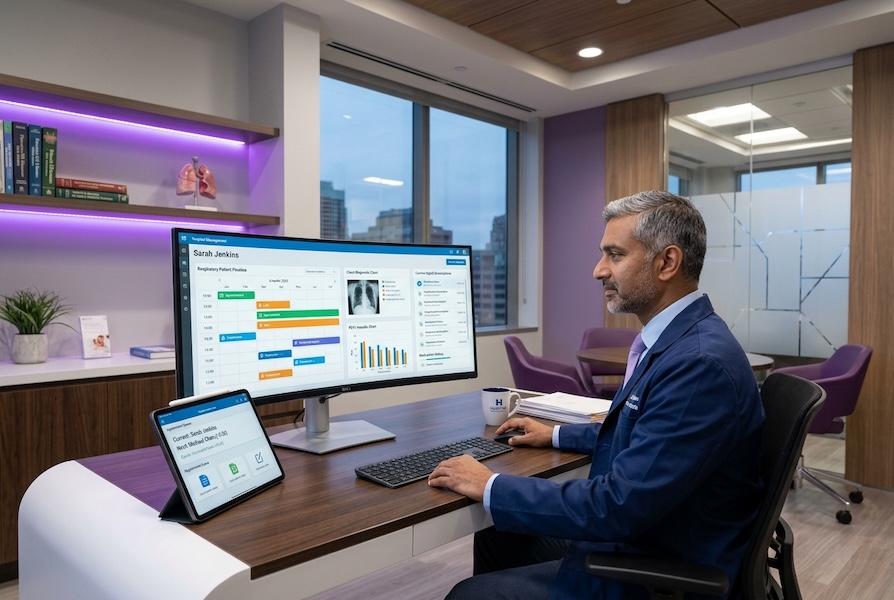
Dr. Swapnil Chaudhari
Pulmonologist (Chest Physician) Practice Digitalization & Longitudinal EMR.
Read Case Study →
Padmavati Packaging
Automated quotation calculation from box dimensions & sales-to-dispatch flow.
Read Case Study →